How Excess Water Pressure Causes Intermittent Whistling Sounds in Washing Machine Solenoid Valves
How Excess Water Pressure Causes Intermittent Whistling Sounds in Washing Machine Solenoid Valves
A tiny whistle that goes up and down each time your washing machine starts to fill can be amazingly hard to ignore, especially when it shows up one day and is gone the next. Many homeowners assume the equipment itself is malfunctioning, so they worry about costly repairs or an early replacement. In fact, the noise is often more linked to the water supply than the device itself. The intake solenoid valve is a precision component that requires a stable mild pressure to open and close softly and excess pressure can push it beyond the comfortable operating range. The high speed flow of water through tight tubes gets turbulent causing the internal parts to vibrate and produce a thin high pitched whistle. This article describes how the valve works, the importance of pressure, the why and when of noise, and how to troubleshoot and fix it safely.
How Do Washing Machine Solenoid Valves Work?
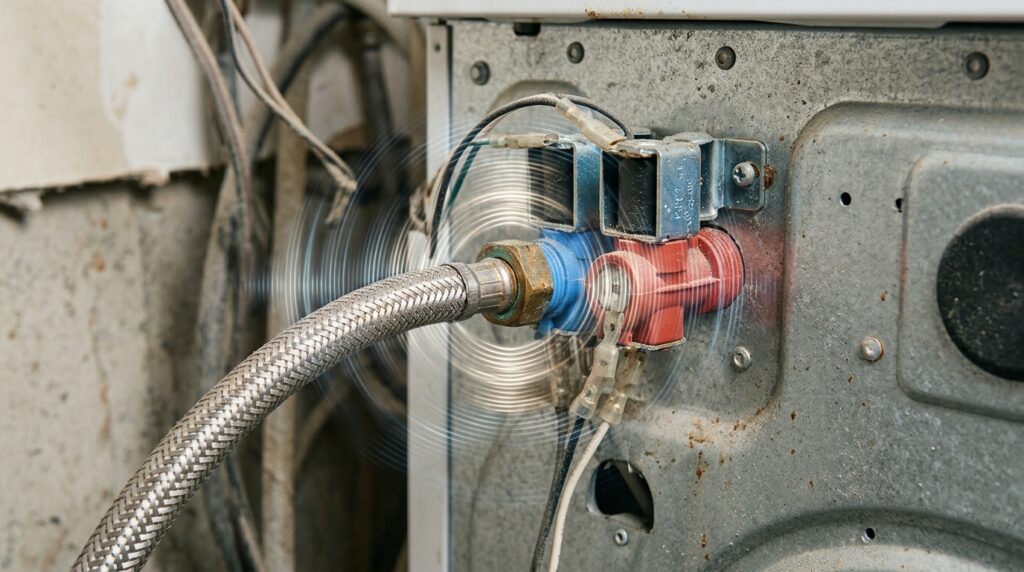
All automated washing machines have an inlet valve assembly to which the hot and cold supply hoses join at the rear of the cabinet. In the case of the valve body there’s an electric coil in the valve body, or solenoid, that creates a magnetic field when the control board provides power. This field lifts a small plunger, which opens a small pilot port and lifts a flexible rubber diaphragm off its seat. Water then exits the valve and goes through a short outlet line into the tub. When power is lost a spring returns the plunger back down, the pilot port closes up and line pressure helps to firmly close the diaphragm. The design uses narrow channels and thin flexible elements limiting these to about 20 to 120 psi however quiet operation is significantly more possible if pressure is kept mild.
High water pressure causes whistling sounds
When water pressure, the force that drives water through pipes, is too strong, water will pass through constrained apertures at considerably greater velocity. The smallest passages in the solenoid valve include the pilot port, intake screen, flow restrictor, and the space between the diaphragm and its seat. The fast moving water passing these edges sheds tiny swirls, termed vortices, in a continuous beat. If that rhythm fits the natural vibration frequency of the diaphragm or plunger, the part begins to flutter. The flutter is perceived as a whistle or a high screech. When you crank up the pressure, you make the swirls spin faster and pack more energy, which makes the resonance louder and stronger. For residential plumbing, the ideal pressure is usually between 40 and 60 psi. Readings above 80 psi are usually too much for domestic fixtures and appliances.
Why the whistling is not continuous
When the noise is intermittent, it is usually pressure, and not a part, that is causing the problem. The pressure in the municipal supply is seldom consistent, and tends to rise during the late nite and early morning hours when use by neighbors is low. Run a washing machine at noon, it may fill silently. Run that same load at midnight, it may whistle loudly. Elevation, distance from the main line and local pumping stations also affect what actually comes to your property. The cycle is important also . A cold only fill utilizes one valve . A warm wash opens two valves and splits the flow between them . Some machines whistle only for the initial few seconds of a fill when the supply line is at its peak pressure, and then settle down once the water is flowing regularly.
Flow Restrictors and Clogged Screens, Partially Closed Shutoff Valves
It is not simply the pressure as the state of the supply path can make a moderate pressure a noisy one. A half closed shutoff valve is like a nozzle . It speeds up the water before it ever gets to the washer . Older multi turn valves with worn internal washers typically don’t open fully and can whistle on their own even when the machine is not in use. The washer has fine mesh screens on the inflow ports that trap sand, rust flakes and mineral grit. As debris builds up , the open area becomes smaller and the remaining holes pass water more quickly , increasing the vibration inside the valve . Small plastic flow restrictors designed to limit fill rate can potentially get broken or partially clogged. Open each cutoff fully and clean the screens periodically and you will much reduce the noise.
Worn Diaphragms, Mineral Scale, Valve Wear Contribute To The Problem
An aged valve can be far more sensitive to pressure, even if the pressure is in a reasonable range. Rubber diaphragms get rigid and lose their flexibility over the years. A diaphragm that is stiff or somewhat deformed may rattle on its seat instead of flowing smoothly. Hard water deposits scale around the pilot port and seat . This creates sharp edges that impede flow and create extra turbulence . A weak spring or a plunger with some residue on it can cause the valve to open in a hesitating, partial way and this is the very condition under which whistling is most likely to occur. In such instances the noise is a composite of pressure and wear, so that decreasing the pressure may quiet the machine only partially. If the valve leaks after the cycle has finished, drips in the tub or fills slowly, replacement is usually a better option than cleaning it repeatedly.
Simple Household Water Pressure Test using a Gage
There is no way to reliably get an answer by trying to guess pressure, but a basic gage is cheap and quick to use. Get a hose thread pressure gage, screw it onto an outside spigot or the laundry hookup (with the washer detached), and turn the valve all the way on. Make sure there are no other fixtures running so you are getting static pressure and not a transitory drop. Take the reading at different times, in the late nite and early dawn, as the highest value is the one that stresses the valve the most. A measurement of 40 to 60 psi is healthy, and anything continuously above 75 or 80 psi needs modification. If you write down each of the numbers next to the times that the machine whistled, the relationship between pressure and noise is much easier to see.
Hose Upgrades, Point of Use Regulators, & Pressure Reducing Valves
If the tests show that the pressure is too high, the best solution is to have a pressure-reducing valve installed at the point where the main water line enters the house. Most types have a screw or bolt to adjust to keep the downstream pressure around 50 to 60 psi. A licensed plumber can usually install or repair one in a few hours. The similar noise can be caused by an existing regulator that has wandered out of adjustment, which is typically the case after ten to fifteen years of service. If a new regulator is installed, it may produce a closed plumbing system and a thermal expansion tank may be needed to protect the water heater and pipes. For a lesser fix, a regulator built for washing machine hookups can lower pressure at the appliance itself. Quality braided stainless steel hoses and water hammer arrestors also help to quiet pressure spikes.
Long-term Prevention and When to See a Specialist
When the whistling is gone, a few everyday habits will keep it away for good. Check and rinse the inlet screens every six to twelve months and check each of the supply hoses for bulges, cracks or corrosion around the couplings. Check your water pressure once or twice a year, especially following any municipal repair work or fluctuations in the supply with the seasons. If you live in an area with hard water, occasional descaling and a whole house softener can help preserve the valve diaphragm and seat against accumulation. If the pressure is still excessive after adjustment, if you can hear banging in the walls, or if the valve leaks, call a professional. You can often replace a washing machine fill valve, if you are a confident homeowner. Changes to the main water line are the province of a licensed plumber. High pressure also wears out faucets, toilet fill valves and water heaters over time.