Identifying Causes of Microwave Glass Turntable Stuttering Under Heavy Food Loads
Identifying Causes of Microwave Glass Turntable Stuttering Under Heavy Food Loads
A common household complaint is a microwave turntable that glides easily with a cup of coffee, but jerks, pauses or stutters when you put a big casserole dish on it. It may seem a small oddity that the motion is uneven, but it can result in cold spots in your food and bothersome clunking noises, and at times, it can indicate a part is close to failing. Many owners think the glass plate is just too hefty. But a healthy turntable system should have no problem with standard meal quantities. When it doesn’t, it’s likely a worn coupler, unclean roller ring, fatigued motor or plate that no longer sits level. The spinning assembly is made of cheap plastic and a little low speed motor thus any wear is visible as soon as you put any weight on it. Here’s how the system works, why severe loads expose hidden flaws, and how to safely and economically detect and cure the stuttering.
The Microwave Turntable System How it Works
The turntable is used to transport food across the uneven pattern of microwave energy inside the chamber, resulting in more even heating from the edges to the center. Below the floor of the cavity is a small synchronous motor, which turns a short drive shaft at only a few revolutions per minute. A plastic coupler (also known as a drive hub or turntable spindle) glides over that shaft, into a matching socket on the underside of the glass tray. The hollow floor has a plastic roller ring with three or more small wheels that allow the outside section of the tray to rest on the ring and maintain it level and stable. The coupler transmits torque, and the rollers carry most of the weight and guide the rotation. All of the pieces need to operate together and a failure in one can throw off the smooth rhythm.
How heavy food loads expose hidden weaknesses
A light load puts very little stress on the system, therefore slight flaws often lie undetected for years. A worn coupler can still catch the tray enough to turn a mug, and a sticky roller wheel can still roll with not much pressure on it. A heavy dish changes the story, because more weight means more friction at each contact point, and more torque that the motor must provide. A normal microwave has a motor that produces a small amount of force . It has a low reserve strength . If the friction surpasses this reserve, the plate slows down, the motor is overstressed and the tray catches and then releases in a sequence of jerks. The difficulty is made even worse by dishes filled with liquid likewise changing their weight as they revolve. So stuttering under load is an early warning of wear, not just a random malfunction.
Cracked or worn drive couplers and hubs
The drive coupler is one of the most common culprits, in part because it is inexpensive, tiny, and exposed to heat and spillage. The plastic arms or teeth can round off over time, losing the ability to retain the coupler firmly in the tray socket and letting it slip inside. Heating and cooling can also cause recurrent hairline cracks . A coupler that appears sound at first glance will open up along those cracks as soon as the torque increases . With a strong load, the motor shaft may keep turning while the plate lags, and lurch forward until the worn edges finally engage. Make sure the coupler fits securely on the shaft. The socket on the tray should also have rounded corners or melted plastic. Replacement couplers are cheap, easy to find and generally press on by hand but the part must be specific to your model.
Misaligned, Damaged or Dirty Roller Bands
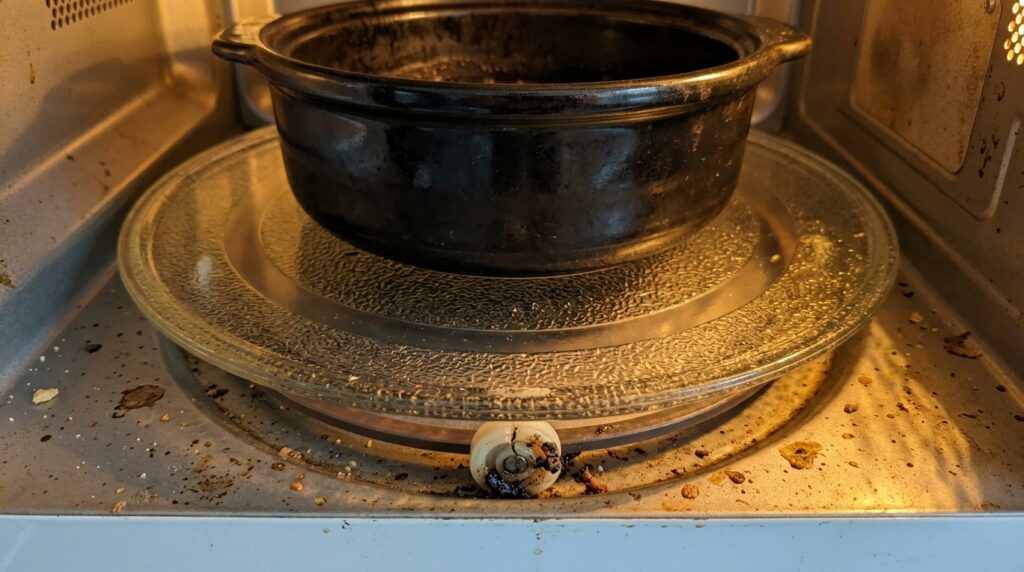
Most of the weight rests on the roller ring, hence the condition of the roller ring has a big effect on how smoothly the plate turns. Grease splatter, dried sauce and food crumbs gather in the track on the cavity floor and set into a gritty coating that makes the wheels drag instead of roll. Wheels themselves can break, flatten out or seize on their axles, causing flat patches that emit a repetitive bump with every round. If a ring is upside down or just a little off the track, it will wobble and a bent ring will not support the tray equally. Remove the ring and spin each wheel with your finger to see that they all turn freely. Wash the ring in warm soapy water, clean the cavity track well and replace the ring if any wheel feels stiff or damaged.
Uneven Weight Distribution with Distorted Glass Trays
Even with a faultless drive system, if the glass tray itself is out of true it will stutter. Thermal stress (e.g. rinsing a hot plate under cold water) may cause tempered glass to bend slightly or develop microscopic chips along the rim and underside. A plate no longer flat rocks on the rollers, and the rocking is more noticeable with increased weight. A tray from another type, or with a different diameter may also cause poor interaction with the coupler and rollers. Loading habits are also important. A huge, off-center dish causes unequal pressure, so the plate tips to one side and drags along the rollers or the wall of the chamber. Focus on the food, and use plates that the food fits nicely inside of, and avoid containers that touch the walls. This will decrease the strain and maintain the rotation even.
Worn Internal Gear Teeth Weak Turntable Motors
Otherwise, if the coupler, rollers and tray check out, the motor assembly is the next suspect. The turntable motor has a reduction gear train built in, and the little plastic or nylon gears within can wear, lose teeth, or become brittle with age. A motor with worn gears can easily spin an empty plate, but will slip as soon as the torque increases. Internal windings can also become weakened. This causes the motor to hesitate and lowers force. The heat from the cavity, oil fumes and years of regular use degrade motor life, particularly in microwaves used many times a day. Common symptoms are weak ticking or buzzing under the cavity, a plate that stops dead under strain, and a shaft that turns too freely by hand. The motor itself is cheap but you have to open the cabinet thus it is a work for skilled hands.
Warning Signs and Basic Diagnostic Tests
A systematic approach means the possible reasons get separated fast. Start with an empty cavity. Watch the plate turn through at least one full rotation. Listen for clicks, scrapes or rhythmic thumps. Then add some mild weight, such as a glass of water, and repeat the observation to determine if the problem only arises under stress. Remove the tray and ring and insert a cup of water in the cavity as a safe load, operate the machine for a short time and see if the coupler spins steadily by itself. Determine if the original tray is faulty by substituting another suitable plate on the coupler. Listen for where the stutter is. If it is in the same place on each spin, it means a bad roller wheel or a warped region. Write down everything you see, because the specifics aid when ordering parts.
Repair, Replacement and Prevention Strategies
Most of the difficulties of stuttering can be overcome with easy low-cost steps. Before you get your hands dirty, unplug the microwave. Clean the roller ring, the cavity track and the coupler first. If you see cracks, flat patches, or rounded teeth, replace the part with one from the manufacturer, not a generic part that might not fit perfectly. Frequently a new coupler or roller ring will restore smooth motion instantly. If the motor is the problem, a certified technician would have to replace it because there is a high-voltage capacitor in the cabinet that can hold a deadly charge long after the plug is unplugged. Replacement is often the better option when the cost of repairs approaches the cost of a new unit, especially on older, low-wattage versions. To prevent a recurrence, stick to the weight recommendations in the instructions, let heated glass cool down before washing it, clear up spills right away and clean the track once a month.