Identifying Causes of Range Hood Backdrafting During High-CFM Bathroom Exhaust Fan Usage
Identifying Causes of Range Hood Backdrafting During High-CFM Bathroom Exhaust Fan Usage
Most homeowners don’t anticipate cold air, cooking scents or even a slight exhaust smell to waft from the range hood while a bathroom fan operates down the hall. But as dwellings are built tighter and ventilation technology becoming more powerful, this change in air flow direction, called backdrafting, is happening more often. Bathroom exhaust fans draw air out of the building and that air has to be replenished by something. If a house doesn’t have a simple means to get fresh air in, the air it lacks will be sucked in through whatever entrance gives the least resistance, and an unused range hood duct is commonly that hole. The consequence can be an annoyance, such drafts and lingering scents, or a significant safety issue in the case of combustion appliances. This article discusses what backdrafting is, how high-CFM bathroom fans cause it, what building and equipment conditions make it worse, and what tests and remedies bring back correct airflow.
The Real Meaning of Backdrafting in a Range Hood
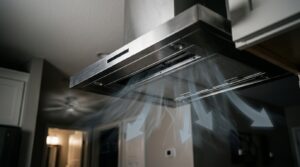
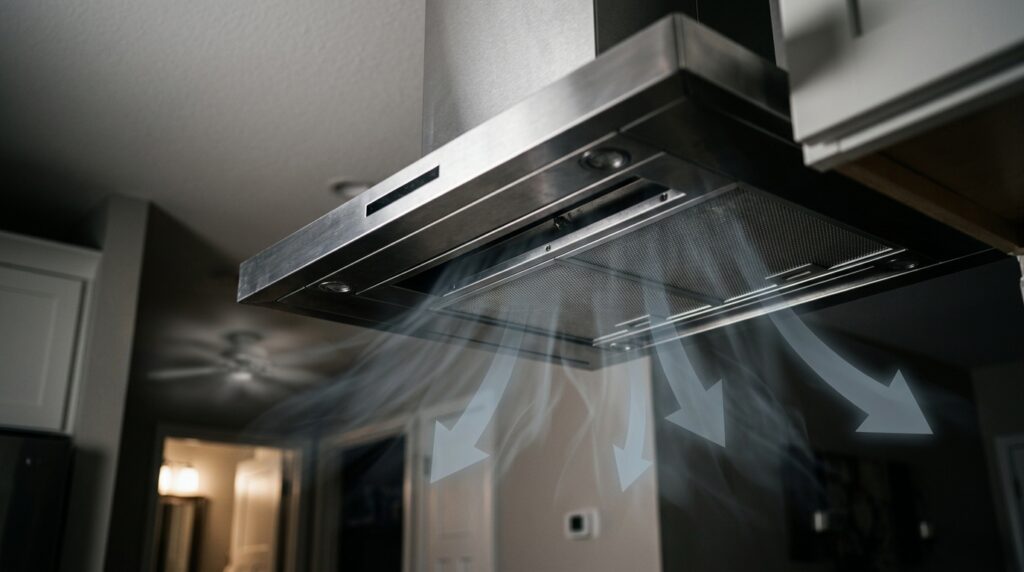
Backdrafting is the reverse movement of air via a duct, flue or vent designed to convey air out of the building. In the kitchen, it happens when outside air, attic air, or stale duct air comes down through the range hood duct and into the room. Homeowners commonly feel a cold breeze blowing over the stove, a damper that flaps or rattles, the smell of oil or outside aromas or the sound of wind blowing through the hood. Backdrafting is the result of a pressure differential between the home inside and the outside, unlike a basic draft from a window. If the pressure inside the building is less than the outside pressure , air will enter through whatever openings it can find . The hood duct has a wide cross section , and often becomes the easiest path for air flow . The first step to a correct diagnosis is to understand this is a pressure problem not a hood defect.
How a High CFM Bathroom Exhaust Fan Creates Negative Pressure
CFM, or cubic feet per minute, tells you how much air a fan moves. Standard bathroom fans move around 50 to 110 CFM. Newer versions, including those installed in big primary bathrooms, can be above 150 CFM. For every cubic foot thrown outside, a cubic foot must come in, or the pressure declines in the house and it becomes depressurized. In an old drafty house, air will seep in through the cracks surrounding windows, outlets and attic hatches, so the effect is limited. In a modern airtight house, the leakage channels are small, and even a moderate fan can cause a significant negative pressure. The more you run the fan with the bathroom door closed the greater the effect , as the rest of the home can not simply replace the air in that room . The pressure imbalance carries over to the kitchen .
Tight Construction of Houses and Limited Make-up Air
Air sealing, continuous insulation and high performance windows are required by modern energy rules, and these changes greatly reduce natural air leakage. A house that once exchanged its air with the outside multiple times an hour may now do so fewer than once in three hours, cutting heating and cooling expenditures but limiting passive makeup air. Weatherstripping, spray foam, sealed ducts and tight attic hatches take care of the little leaks that used to balance exhaust fans. In a tight dwelling without a dedicated fresh air inlet, every exhaust equipment must draw replacement air through unintended paths. Renovation work- installing new windows, adding attic insulation, for example- can change a comfortable home into one where backdrafting starts. Homeowners commonly remark the problem came up after a makeover, and that timing is a strong indication the building envelope is tighter than its ventilation system can cope with.
Range hood ducting with failed or jammed dampers
Each range hood duct should have a backdraft damper, a lightweight flap or blades which opens when the fan runs and closes by gravity or spring when it stops. If the damper is missing, bent, plugged with grease or stuck open, it can not prevent reverse flow and even a tiny pressure differential will carry air down into the kitchen. Dampers at the wall or roof top might freeze shut in winter, accumulate lint and nesting material, or jam open due to debris. Many cheap hoods employ thin plastic flaps that warp with the heat. On some installations you have only the outer cap, with no inside damper. If the damper is weak you can often hear a faint ticking or fluttering sound when the bathroom fan turns on. A fast and inexpensive examination that often explains the problem is to check the damper in the hood collar and the damper at the external termination.
Duct Layout, Leakage and Termination Problems
Even a good damper can’t entirely overcome bad duct design. Short, straight ducts with large diameters, such as eight or ten inch circular pipes intended for strong hoods, offer extremely little resistance and allow air to go in either direction with easily. Unsealed connections, leaky joints and ducts that pass through unheated attics or wall cavities are further avenues for air exchange and can convey moisture and aromas to places you might not expect. The place of termination also counts. Pressure fluctuations that force air back can occur on a wall cap that faces the prevailing wind, a roof cap that does not have a sufficient hood, or an exit near a gable vent. Things can be worse if you have a crushed flex duct or a duct that ends beneath a soffit instead of outside. Sealed rigid metal ducting with the right cover is a good way to help insure better, more predictable airflow.
The Stack Effect and Conflicting Exhaust Appliances
Bathroom fans rarely function alone. The combined action of many exhaust devices frequently determines whether backdrafting happens or not. A clothes dryer will pull about 150 CFM, a kitchen range hood several hundred more, and a second bathroom fan or full home fan adds to the total. The bathroom fan in that environment could be the straw that breaks the camel’s back that sends a borderline home into depressurization. The stack effect puts a layer on top. Cold weather forces the warm indoor air out at the top, lowering the pressure at the floor and drawing cold air in at the bottom. Then a kitchen on the main level pulls more strongly inward. Wind can cause high pressure on one side of the house and low pressure on the other. These forces alter hourly and seasonally, thus backdrafting may occur just on a cold morning or a windy evening, making the problem seem arbitrary.
Combustion Appliances and Carbon Monoxide Safety Hazards
A kitchen draft is annoying, but the more serious problem is what depressurization does to fuel-burning appliances. Older furnaces, boilers, fireplaces and atmospheric water heaters use natural draft to convey the combustion gasses up a chimney. If the house pressure drops low enough, the flue can reverse and suck carbon monoxide and other combustion products back into the living space. Carbon monoxide is a colorless, odorless gas and symptoms such as headaches, dizziness and nausea might be mistaken for a common sickness. Soot around burner apertures, flame rollout, and water heater flue spillage are key warning indicators. Install carbon monoxide alarms on every floor and in sleeping areas, check them often, and consider every alarm as serious. If you have a gas or oil appliance and you see range hood backdrafting, schedule a combustion safety inspection as soon as possible.”
Diagnostic Tests and Practical Solutions
Begin with a simple observation test. Close the interior doors, operate only the bathroom exhaust fan, and hold a smoke pencil or incense stick near the range hood collar to see the direction of the smoke movement. Repeat the test with a window open a crack, because if the backdraft goes away, a lack of makeup air is almost probably the problem. To get a more precise answer, a technician can use a digital manometer to determine the pressure differential between the house and the outside world, and many recommendations consider a reading of negative 5 pascals to be a worry for atmospheric equipment. Solutions include repairing the damper, adding door undercuts or transfer grilles, adding a separate makeup air duct with motorized damper, or adding a heat recovery or energy recovery ventilator to provide balanced ventilation. It also lowers the pressure imbalance by selecting a bathroom fan that is suitable for the room, rather than an excessive device.