The Stack Effect: How Crawl Space Air Pressurizes Attic Cavities
The Stack Effect: How Crawl Space Air Pressurizes Attic Cavities
A lot of people assume that the air in their home is quite motionless unless the heating or cooling system is running. In practice, there is always a flow of air through the building due to changes in temperature, pressure and height. One of the most important, but least understood, causes underpinning this shift is the stack effect. This natural process moves air from lower portions of a building, including crawl spaces, up through the building structure and into attic cavities. Warm air rises, creating pressure differentials that impact indoor comfort, energy efficiency, moisture and even indoor air quality. Understanding how crawl space air pressurizes attic cavities helps to understand why seemingly unrelated issues often occur in tandem. Understanding the influence of the stack effect helps homeowners make more informed choices about insulation, air sealing, and the long-term performance of their structure.
Basic Principle of the Stack Effect
The stack effect is a natural air movement due to changes in air density. Warm air is less dense than cool air, thus in a confined place it will naturally rise. In winter, warm indoor air travels up through walls, floors, and concealed spaces to the attic. Small apertures near the roof allow the air to escape creating lower pressure in the living space and lower floors of the home. The air that escapes is replaced by drawing outside air through crawl spaces, basements, or other openings below. This cycle establishes a vertical route for airflow that exists even with the windows and doors closed. The movement is sometimes unnoticeable but has a major impact on the performance of almost every section of the building envelope.
The Main Source of Air is Crawl Spaces
Crawl spaces often be the main source of replacement air, as there are several entrances to the outside in a crawl space. Air from outside can leak in through vents in the foundation, holes around utility penetrations, cracks in the brickwork and unsealed access doors. Once this air is in the crawl area, changes in pressure cause it to flow up through plumbing penetrations, electrical holes, framing gaps, and other unseen paths. Homes with poor floor sealing allow air from the crawl space to pass considerably more readily into living areas. The warm air within your house continues to leak out through the attic, and the pressure imbalance keeps sucking in more air from below. This constant cycle makes crawl spaces a crucial part of the home’s overall airflow system, not separate regions under the floor.
How Air Moves Through Interior Cavities
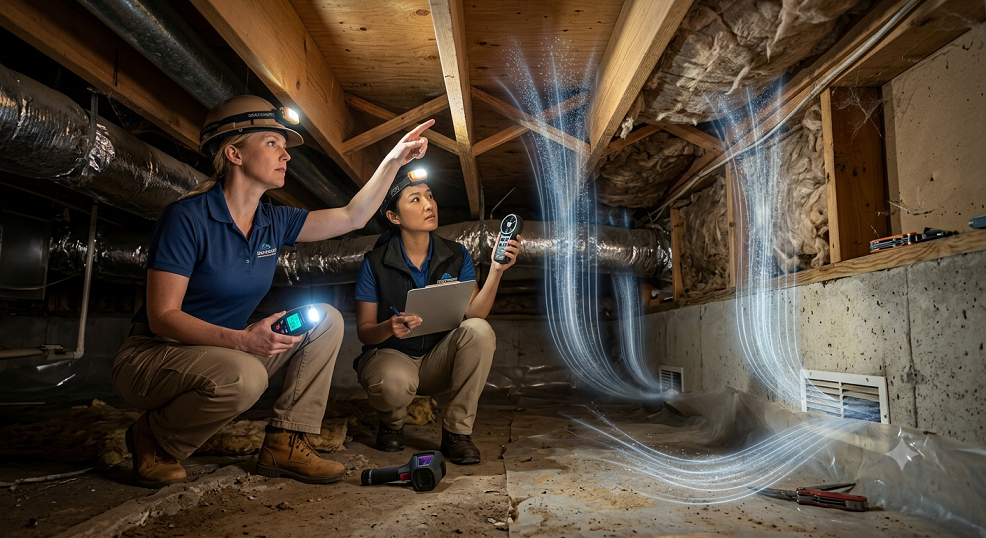
The passage from the crawl area to the attic is seldom one big opening. Instead, air travels through several inter-connected voids hidden within walls, floor systems, and utility chases. There are typically continuous vertical paths in the spaces behind plumbing pipes, electrical wiring, HVAC ducts, and chimney structures. What causes the upward movement is microscopic gaps around structural joints that add up over the whole home. Air moving through these hidden passages finally reaches the attic, where there is less pressure than in the occupied living space. Since these paths are concealed under completed surfaces, homeowners generally underestimate the amount of air that moves through the structure every day. The small leaks scattered all throughout the building add up to a remarkably efficient network of air flow .
Temperature Differences & Air Pressure
The strength of the stack effect is directly influenced by the temperature difference between the inside and the outside. In winter, the air within is heated and becomes considerably warmer than the air outside, which means a bigger pressure difference that pushes the air higher. The bigger the temperature differential, the stronger the stack effect. This is more pronounced in multi-story homes, where the vertical height is larger, and hence the pressure difference between the attic and crawl area is greater. Even in temperate areas seasonal changes in the temperature can result in observable changes in airflow patterns. Air conditioning may reverse some of the pressure relationships in summer, but winter temperatures tend to cause the most vigorous upward air movement. Seasonal fluctuations like these can account for why some construction defects appear to be more prominent during certain periods of the year.
How Moisture Travels from Crawl Space to Attic
Airflow isn’t just air. Moisture, in the form of water vapor, goes where the air moves, hence the stack effect is critical in moisture management. Humid air might enter the building from damp soil or plumbing leaks or poor drainage in crawl spaces. This moist air rises through the interior cavities and makes contact with cooler attic surfaces . If the conditions are favorable , the moisture will condense . This ongoing moisture transport can cause wet insulation, soggy roof framing and high attic humidity. Over time, excess moisture can cause wood to deteriorate, insulation effectiveness to decrease, and conditions favourable for biological growth. Thus, controlling moisture at the level of the crawl area helps safeguard the entire building above it.
Energy Efficiency and the Impact of Heat Loss
The stack effect is a major contributor to the total energy performance of a home. As conditioned indoor air flows out through attic leaks, heating and cooling systems must continually replace the lost air. This raises energy usage and puts extra stress on HVAC equipment. Meanwhile, the replacement air that is drawn in through subterranean spaces is often at outdoor temperatures, and needs to be further conditioned before appropriate indoor temperatures can be restored. With high air leakage, homes often have uneven room temperatures, cold floors, and drafts all the time, despite having enough insulation. Air sealing the attic and the crawl area prevents uncontrolled air movement, which helps insulation do its job better and saves on heating and cooling costs all year long.
How to Know If the Stack Effect is Affecting Your Home
The stack effect can influence indoor conditions, and there are several typical household symptoms that may suggest this. In winter, cold floors are commonly caused by outside air leaking into the crawl space. Drafts near electrical outlets, baseboards and interior walls can indicate pressure driven air movement through concealed holes. High energy bills, uneven room temperatures, and excessive dust and moisture build-up in the attic of upper portions of the structure may also be signs of uncontrolled vertical airflows. This air rises carrying with it any scents from the crawl space which in certain houses can be detected in living areas. Each of these symptoms might be caused by many things, but when they occur together they usually indicate that the building envelope needs better air sealing and pressure control.
Methods of Control of Stack Effect Airflow
To minimize the influence of the stack effect, one must be mindful of both the bottom and top of the building. One of the best ways to minimize loss of conditioned indoor air and minimize pressure differences is to seal air leaks in the attic. Concurrently, crawl spaces should be secured by eliminating unwanted openings, enhancing moisture control, and repairing air leaks in the foundation. Insulating exposed surfaces and properly sealing penetrations for plumbing, electrical and ducts further block undesirable airflow routes. Balanced mechanical ventilation can assist balance interior pressure while ensuring healthy air quality. Instead of thinking of the home as a series of individual rooms, look at the house as a complete air system and home owners can increase comfort, reduce energy loss, and prevent moisture problems in the house that can be caused by the stack effect.