Identifying Asphalt Driveway Alligator Cracking Caused by Subgrade Failure
Identifying Asphalt Driveway Alligator Cracking Caused by Subgrade Failure
Asphalt driveways are designed to provide a durable, flexible surface capable of withstanding repeated vehicle loads, temperature fluctuations, and environmental exposure. Properly built on a sound base they can last many years with little upkeep. One of the most severe forms of deterioration that asphalt pavements suffer, however, is alligator cracking (sometimes called fatigue cracking). This pattern shows as interwoven, polygonal fractures like the skin of an alligator and is typically a clear indicator of deeper structural concerns beneath the surface layer. Minor cracking may be related to surface aging and oxidation . However, in general, widespread alligator cracking is connected with failure of the underlying subgrade. It is important to understand how subgrade failure causes asphalt alligator cracking in order to properly diagnose the status of your driveway, prevent further deterioration and to determine if you need to do a surface repair or a full structural rebuilding.
How to Interpret the Structure of Asphalt Layers
An asphalt driveway is made up of several layers that work together to spread loads and give stability. The top layer consists of compacted asphalt pavement, which offers a smooth, weather-resistant surface. Underneath is a base of crushed stone or gravel to disperse the weight of the vehicles evenly. The subgrade is a layer of compacted earth underneath the base layer and supports the entire pavement system. The strength and stability of the subgrade are integral to the structural integrity of the driveway. If the soil under the driveway is weak, moist or improperly compacted, then the layers above lose support, which in time causes the surface to distort and break.
Alligator Cracking: What It Looks Like
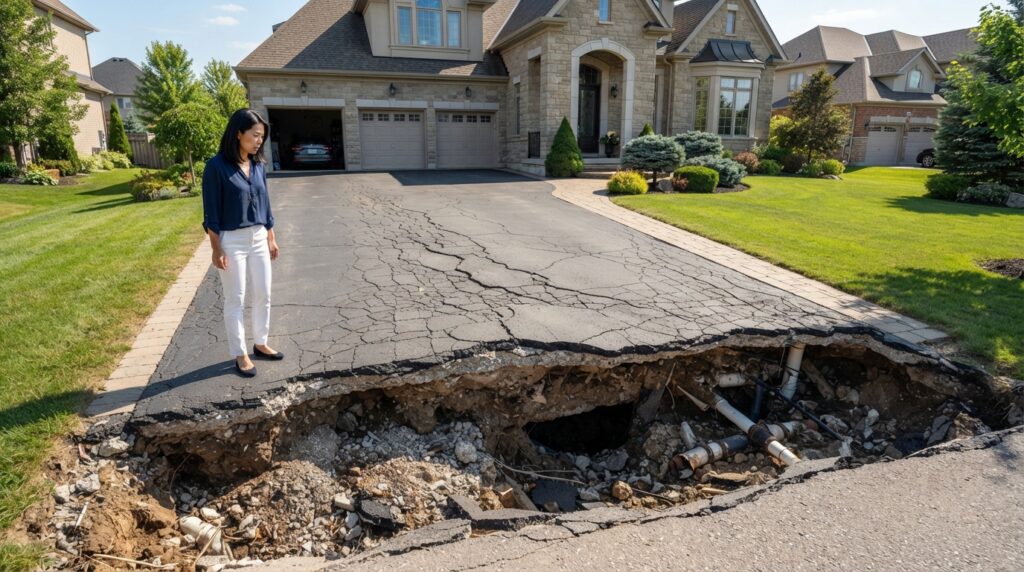
Alligator cracking is indicated by a network of inter-connected cracks in irregular, geometric forms on the surface of the asphalt. Alligator cracking usually occurs in particular locations subjected to repetitive stress, as opposed to linear cracking due to thermal expansion or slight shrinkage. These zones usually correspond to wheel tracks where the vehicle weights are concentrated. Initially the fractures may be tiny and hairline in appearance but over time they get bigger and interconnect to form a pattern resembling scales. As the problem advances, small portions of asphalt may loosen or break away entirely, revealing the underlying foundation material.
How Subgrade Failure Develops
Subgrade failure is when the soil under the driveway can no longer sufficiently support structural loads. This can be caused by poor compaction at the time of building, by too much water getting in, or by natural soil movement over time. Water that leaks into the asphalt surface through cracks or edges can saturate the subgrade and decrease its load-carrying capability. Clay-rich soils are more sensitive to swelling when wet and shrinking when dry, creating unstable conditions under the pavement. Repeated freeze-thaw cycles can further damage soil structure, resulting to uneven settling and lack of support beneath the asphalt layers.
Repeated Traffic Loading Effects
Vehicle traffic is a major factor in the acceleration of alligator cracking after subgrade support has been lost. Every time a car drives on the driveway it applies focused pressure to the surface of the pavement. In a stable system these loads are distributed uniformly over the base and subgrade layers. But if the subgrade gets weak, the asphalt layer starts to flex too much beneath the load. This repetitive bending leads to fatigue in the asphalt material and the development of linked cracks. Once structural support is compromised, even routine household traffic can greatly contribute to the situation over time.
Signs of Cracking – Early Warning
There may be various subtle signs that the subgrade is not performing well before you see alligator cracking. Minor dips or soft places in the surface of the driveway are frequently indications of localized soil settlement under the asphalt. A downpour can also cause water to collect in some spots, which is a sign that the subgrade is not evenly supported. Sometimes you may sense the driveway is a little spongy or pliable beneath the weight of a vehicle. This is a sign that the base layers have lost their stiffness. First small longitudinal or transverse fractures may emerge, giving water a way to get in and to exacerbate subgrade weakening.
Measuring the Degree of Structural Damage
Diagnosis Properly diagnosing alligator cracking includes evaluation of surface conditions and underlying structural integrity. Severity of cracking patterns gives an indication of the stage of subgrade failure. Localized surface cracking of small regions may be the sign of an early stage fatigue, which can occasionally be locally repaired. However, if the cracking is substantial and is accompanied by surface deformation, rutting or subsidence, then you have deep structural failure and extensive rehabilitation is necessary. In extreme circumstances, core sampling or subsurface inspection may be needed to evaluate the quality of the asphalt’s base and soil layers.
Distinguishing surface deterioration from subgrade failure
Not every cracking in asphalt is a sign of structural breakdown. Oxidation surface aging often causes small linear cracking that progresses slowly across wider parts of the driveway. Usually, the fissures are shallow and they do not join up with each other. On the other hand, alligator cracking resulting from subgrade failure is confined, deeper, and structurally interrelated. It is often linked with noticeable deformation or movement of the pavement surface. This distinction is important to understand since surface problems may typically be fixed by sealcoating or resurfacing, but subgrade failure requires more substantial structural rectification.
Repair Strategies and Long Term Prevention
Subgrade failure leading to alligator cracking often requires more than a surface fix to correct. This degradation to the asphalt and base material means that they have to be removed to get to and fix the soil conditions underneath. Proper reconstruction involves re-compaction or replacement of the subgrade, rebuilding the aggregate foundation, and application of a new asphalt surface layer. It is also important to improve the drainage surrounding the driveway, to prevent water penetration in the future, which may damage the soil again. Routine maintenance such as sealing surface cracks early, regulating run-off and limiting high water accumulation can do wonders for the longevity of the driveway structure.
Homeowners can avoid treating asphalt road alligator cracking as a cosmetic issue and understand how it originates from subgrade failure by recognizing the structural nature of the problem. This insight enables more accurate diagnosis, suitable repair decisions, and long-term maintenance of driveway performance and durability.