Diagnosing Harmonic Vibration in HVAC Ductwork Near Supply Plenums
Diagnosing Harmonic Vibration in HVAC Ductwork Near Supply Plenums
HVAC systems are supposed to transport conditioned air silently and efficiently throughout a building, but under certain situations, they can produce audible vibration and low frequency noise that travels via ductwork. One of the most complicated manifestations of this problem is harmonic vibration around supply plenums where the air flow changes from the air handler to the distribution system. Harmonic vibration is not just the rattling of loose duct joints. It is an organized oscillation that occurs when the dynamics of the airflow, the dynamics of the mechanical blower, and the geometry of the duct interact at certain resonance frequencies. These vibrations can be amplified by sections of metal duct, causing audible humming, buzzing or pulsating noise that often seems to emanate from inside walls or ceilings. By understanding how harmonic vibration originates in HVAC ductwork near supply plenums, homeowners and technicians can identify the core source of system noise, increase airflow stability, and reduce long-term mechanical stress on HVAC components.
Role of the Supply Plenum
The supply plenum is the main chamber where conditioned air is drawn straight from the HVAC air handler and then fed into individual branch ducts. It is located immediately downstream of the blower and, thus, is subjected to high velocity air flow and varying pressure conditions during system operation. The plenum needs to distribute air uniformly to a number of ducts . If the pressure is not stable turbulence and noise will occur . Localized pressure waves can propagate through the duct system as a result of unequal or high velocity flow of air into the plenum. These pressure fluctuations are frequently the first cause of harmonic vibration when they match the natural frequency resonance frequency of the ductwork.
What Is Harmonic Vibration In Duct Systems
Harmonic vibration is the repetitive matching of the inherent frequency of a length of duct or a related structural component with forces caused by airflow. The system begins to oscillate in a steady repeating pattern instead of random noise and the pattern grows larger over time. HVAC ductwork can do this when the blower motor speed, fan blade passing frequency or airflow turbulence matches the physical features of the duct materials. Metal ducts are especially vulnerable as they readily carry the vibration energy longitudinally. When the resonance is excited, then slight disruptions in the airflow might cause disproportionately loud or persistent noise in the neighbourhood of the supply plenum.
How Airflow Turbulence Causes Resonance
The air from the air handler does not always flow in a laminar fashion. Sudden changes of direction, limitations, or high velocity at the blower exhaust frequently make it turbulent. This turbulent air entering the supply plenum can create pressure zones that fluctuate and continually hit the walls of the duct. If these pressure fluctuations occur at a frequency that matches the duct’s natural vibration characteristics, resonance emerges. This resonance can eventually develop into a steady harmonic vibration that propagates via adjacent duct branches, making the noise seem far from its real source.
The Effect of Blower Motor Speed
Variable-speed and multi-speed blower motors can inadvertently cause harmonic vibration if they are operating at or near a resonant frequency of the duct system. As the motor accelerates or decelerates to match the heating or cooling load, it can encounter certain RPM ranges that are in resonance with the duct system. Depending on the blower speed setting, this may cause the vibration intensity to increase or decrease. Homeowners will typically hear the noise change as the HVAC system transitions from low output to high output mode. The fact that it changes is a strong diagnostic clue that the problem is in the airflow dynamics, not loose mechanical parts.
Structural Features That Increase Vibrations
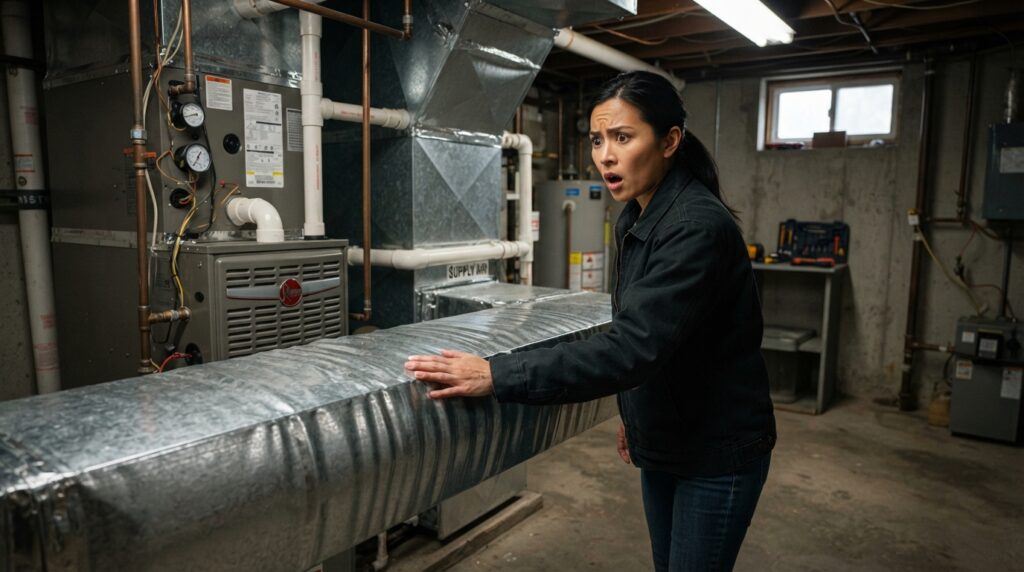
Some duct geometries are more susceptible to harmonic vibration than others. Long straight sections of unbraced sheet metal ductwork can operate as resonant chambers that increase oscillations caused by the airflow. Insulated or reinforced portions of duct are less likely to transfer vibration than thin-gauge metal panels. Poorly supported ducts near the supply plenum may also move slightly with pressure changes, further amplifying vibration. Sharp turns, sudden changes and undersized duct connections can generate turbulence which adds more energy to the system. These structural variables combined produce a setting in which harmonic vibration can occur and persist.
Identification of Acoustic Symptoms
Unlike random mechanical noise, harmonic vibrations near the supply plenums generate specific auditory patterns. Homeowners may be aware of a low-frequency hum, a constant buzz or rhythmic pulse that will persist as long as the HVAC system is running. The noise may seem to resonate through walls or ceilings, making it difficult to detect visually. Sometimes, sound intensity varies with blower speed, outdoor temperature, or system load. This is different from the usual loose duct rattling that also tends to be intermittent. Harmonic vibration will tend to continue as long as the airflow is the same.
Distinguishing Vibration and Mechanical Failure
It is vital to distinguish harmonic vibration from mechanical problems such as failing blower bearings, faulty fan assembly or unsecured duct joints. Irregular grinding or metallic sounds that come and go unexpectedly are usually caused by mechanical breakdowns. Harmonic vibration, conversely, is steady and frequency based. It can alter when the airflow changes, often increasing or decreasing, not due to wear and tear. Listen to the supply plenum region while the system is running to determine if the noise is caused by airflow resonance or physical component movement. Often, simply watching the duct movement or vibration near the plenum will be a good indicator of resonance-related activity.
Harmonic Vibration Diagnosis Methods
Diagnosis starts with determining where in the duct system the noise is occurring and how often. By listening carefully at the supply plenum you can often establish if the vibration is occurring at the air handler connection or further out in the branch lines. Pressure testing might uncover imbalances that are creating turbulent air flow into the plenum. Sometimes infrared tools or vibration sensors can detect small oscillations along the surfaces of the ducts. You might also try changing blower speed setting temporarily to see whether noise changes predictably with the airflow rate. That may assist confirm resonance. A detailed investigation of the duct shape, airflow velocity and structural support will reveal the comprehensive picture of the root cause.
Harmonic Vibration: Avoidance and Minimization
Long term mitigation deals with eliminating the conditions under which the resonance can arise. Properly designed ductwork means better airflow balance and less turbulence into the supply plenum. Providing additional supports or dampening materials at duct portions near the air handler can assist reduce vibration transmission. Flexible duct connectors between the air handler and duct system can be installed to prevent mechanical vibrations from being transmitted into stiff ductwork. In variable-speed systems, adjusting blower speed settings to avoid resonance ranges may also provide quick relief. In more complicated circumstances reworking duct transitions or increasing the size of the plenum can increase airflow stability considerably. By learning how harmonic vibration occurs in HVAC ductwork close to supply plenums, homeowners and technicians alike can understand how airflow dynamics contribute to structural resonance. They can then apply specific solutions to mitigate noise, improve system efficiency and extend the service life of HVAC components.