How to Remove Permanent Marker Stains From Walls and Doors
How to Remove Permanent Marker Stains From Walls and Doors
Stains that have been left on walls or doors by permanent markers may be aggravating, but in many cases, they can be easily cleaned with common home items or focused cleaning techniques. The most important thing is to proceed with caution in order to prevent any damage to the paint, varnish, or surface finish while yet successfully removing the stain.
Determining the kind of surface that is present
Before you make an effort to remove anything, figure out what kind of surface the door or wall has. When it comes to cleaning solutions, painted drywall, wood, laminate, and glossy surfaces all respond in a different way. The possibility of causing unintended harm is reduced by experimenting on a tiny concealed area first.
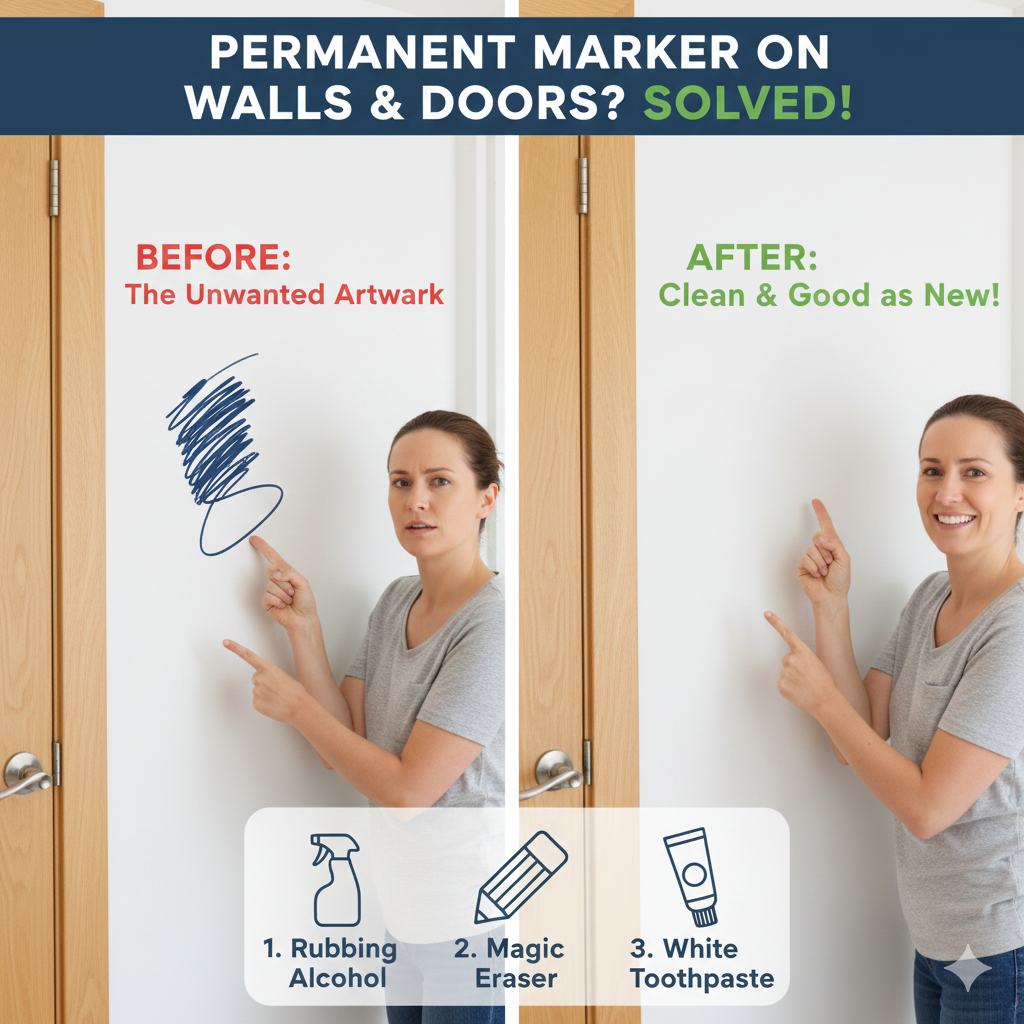
The Use of Either Rubbing Alcohol or Isopropyl Alcohol
Breaking down permanent ink may be accomplished with a great degree of effectiveness by using rubbing alcohol. Lightly dab the stain using a cotton ball or a soft cloth that has been lightly dampened. Make sure to move in a circular motion when you do this. Avoid cleaning with excessive force, since doing so could strip the paint or finish.
Experiment with a combination of baking soda and water paste.
When it comes to sensitive surfaces, a paste that is formed from baking soda and water is a gentle abrasive that will remove marker stains without the need of harsh chemicals. After applying the paste, use a soft cloth to gently massage it in, then rinse with water. If it is required, repeat the process.
Toothpaste for Fast Minor Repairs
Ink stains may also be removed by using toothpaste that does not include gel. Gently massage the region by applying a tiny quantity to a cloth, then clean it by wiping it with a moist cloth. When it comes to painted walls or wooden doors, this procedure is most effective when dealing with mild stains.
Utilizing Melamine Sponges or Magic Erasers
Commonly called as “magic erasers,” melamine sponges are a useful tool for eliminating difficult stains left by markers. Gently massage the stain with a slightly dampened sponge. It is recommended that you test these sponges before using them, since they may somewhat compromise sensitive finishes even though they are able to erase ink without the need for harsh chemicals.
The Cautious Application of Nail Polish Remover (Acetone)
Recalcitrant permanent marker stains that have been imprinted on either wood or metal surfaces may be eliminated with the use of nail polish remover that contains acetone. In order to get the desired results, apply a tiny quantity on a cotton ball, massage gently, and then quickly wipe away any residue. It has the potential to remove the paint if it is used on painted walls, thus it should be avoided in these situations.
Putting commercial stain removers to the test
WD-40 and other specialist cleaning sprays are examples of products that are specifically developed to remove ink or markers. These products may be used to remove permanent ink from surfaces. To avoid damaging the surface, carefully follow the directions provided by the manufacturer and try the product in a concealed location.
Using Protective Measures to Avoid Stains in the Future
The risk of stains occurring as a result of accidents is reduced when washable paints are used, when wall coatings are applied, and when permanent markers are kept away from surfaces. Designated drawing spaces with chalkboards or whiteboards are something to consider for children’s rooms.
Remaining Traces of Stain Following Its Elimination
In order to ensure that no cleaning chemicals remain on the surface, it is necessary to wash the area with warm water and a gentle soap once the marker has been taken out. Make sure that it is completely dry before attempting to return the door or wall to its previous look.
Making Repairs to Surfaces in the Event That Damage Takes Place
If the paint or finish is taken away by the cleaning process, along with the stain, you should touch up the area with paint or wood polish that matches the surrounding area. The appearance and protective capabilities of the wall or door may both be restored to their previous state with the use of proper surface restoration.
Prompt Action in Order to Achieve Optimal Outcomes
It is more straightforward to erase stains from permanent markers while they are new. Responding to the mark in a timely manner minimizes the likelihood that abrasive procedures will be required and increases the probability that the mark will be completely removed without causing harm to the surface.