How to Stop High-Pitched Ringing Noises Coming from Your Breaker Panel
How to Stop High-Pitched Ringing Noises Coming from Your Breaker Panel
It is important to always regard a high-pitched ringing or buzzing sound coming from your breaker panel as a warning indicator of an electrical problem. This is because such a sound is not a typical working state. When electrical panels produce a ringing noise that is sharp, continuous, or oscillating, it is often an indication of anomalous electrical resistance, loose connections, or deteriorating components. However, electrical panels may sometimes create a gentle hum as a result of normal current flow. Due to the fact that breaker panels are responsible for managing the house’s whole electrical distribution system, any strange sound that originates from them deserves careful attention. If you choose to ignore it, it might result in the malfunction of the breaker, overheating, or even, in extreme situations, electrical fire threats.
The Reasons Behind the Sound That Electrical Panels Make in the First Place
Breaker panels are capable of producing a low-level hum as a result of alternating current flowing through coils, transformers, and circuit breakers. This, in most cases, is not harmful and maintains a consistent tone. On the other hand, if the sound becomes high-pitched or erratic, this is often an indication that the electrical energy is coming into contact with resistance or instability located somewhere within the system. It is because of this resistance that the components vibrate at higher frequencies, which results in a sound that is either ringing or whining. When there is a greater imbalance in the load or anything wrong with the connection, the sound becomes more evident.
Insecure connections between the panel and the circuit breakers
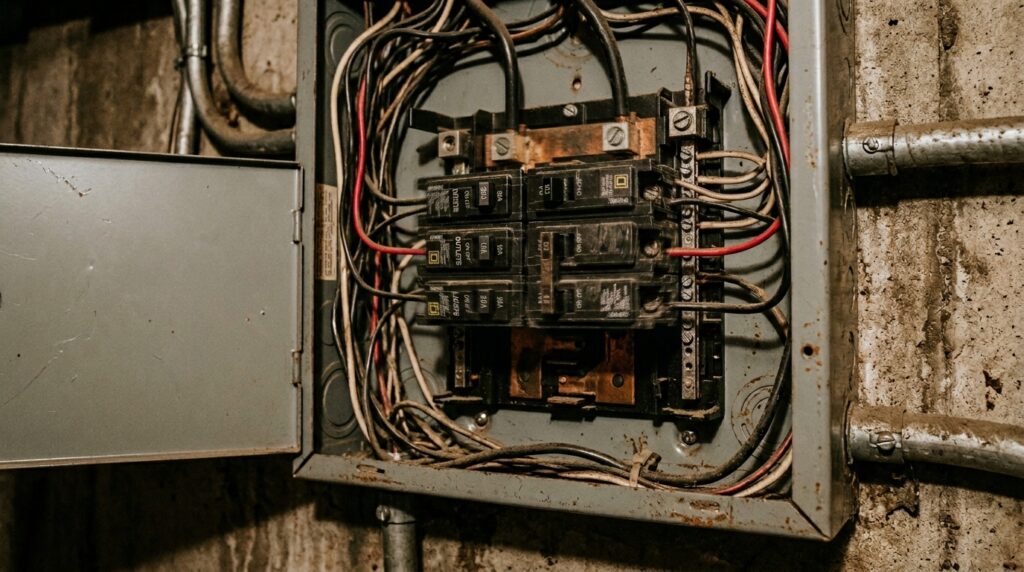
When it comes to the most prevalent causes of high-pitched sounds, a loose breaker or a weak connection inside the panel are two of the most typical culprits. It is possible for electrical current to arc slightly over the connection point if a breaker is not entirely seated in the bus bar after it has been installed. This micro-arcing generates heat in addition to a high-frequency sound that exhibits characteristics similar to ringing or buzzing. In a similar vein, faulty connections to the neutral or ground may result in an unsteady flow of current, which in turn causes vibration inside the panel system. Considering that these problems might get more severe over time and ultimately result in overheating, they are particularly worrying.
The Audible Warning Signs That Are Associated with Electrical Arcing
Arcing happens when electricity leaps over a gap between conductors rather than flowing smoothly via a solid connection. This is the cause of that phenomenon. This process results in the production of heat, light, and sound. Arcing in breaker panels often results in the production of a high-frequency, harsh noise that might change depending on the amount of electrical demand. Corrosion, misaligned wiring, or broken breaker components are all potential causes of this condition. The arcing should be handled quickly by isolating the circuit that is affected and checking the panel. This is because arcing is a forerunner to electrical failure or the danger of fire.
Uneven power distribution and overloaded circuits are also problems.
When circuits are overloaded, breakers are compelled to work at or near their rated capacity, perhaps exceeding their limit. Consequently, this causes the panel’s components to vibrate when subjected to a significant electrical load, which in turn raises the panel’s internal stress. Over the course of time, this tension may cause noises that are audible, such as ringing or buzzing. This problem is particularly prevalent in households that have a number of high-power appliances that are working on shared circuits. Disparities in the distribution of loads across breakers are another factor that might lead to instability in the electrical flow of the panel.
Circuit breakers that are either faulty or old
In the course of their lifetime, circuit breakers are mechanical devices that deteriorate. It is possible that as they age, the internal components of their machines may become less stable, which will result in inconsistent contact with the bus bar. This may cause the flow of electrical current to be interrupted and may also result in audible high-frequency noise. Another possibility is that older breakers can suffer internal wear, which will cause them to vibrate when subjected to standard load levels. To remove both the noise and the underlying electrical danger, it is often required to replace the malfunctioning breaker in situations like these.
Overheating of electrical panels and high levels of thermal stress
The accumulation of heat inside a breaker panel is another factor that may lead to the occurrence of odd noises. Connections that are not secure or circuits that are overloaded may cause resistance to rise, which will result in an increase in heat. There is a possibility that this temperature stress may cause metal components to slightly expand and vibrate, resulting in noises that are ringing or buzzing. Overheating is a significant reason for worry since it hastens the deterioration of components and brings to an increase in the probability of electrical failure. Immediate care is required for panels that have a warm sensation to the touch or that simultaneously generate odor and sound.
Interference from the outside electrical system or malfunctioning appliances
There are occasions when the problem is not inside the breaker panel itself, but rather in a linked device or circuit. It is possible for devices that have motors, power sources, or compressors that are not functioning properly to transmit erratic electrical impulses back through the system. This has the potential to generate feedback noise that seems to emanate from the panel (panel noise). By determining if the sound changes when certain appliances are switched on, it is possible to determine the source of the problem and assist isolate it. An individual circuit, rather than the whole panel, can be the source of the issue in some circumstances.
How to Safely Diagnose Noise Coming from the Breaker Panel
Because of the potential for electric shock or fire, an electrical panel noise diagnosis demands extreme vigilance. To begin, it is necessary to determine if the sound is consistently present or whether it is associated with certain electrical loads. By turning off individual breakers one at a time, it is possible to determine whether or not a certain circuit is the source of the problem. It is probable that the problem is inside the panel itself if the noise continues to be there even after the loads have been de-loaded. It is possible that a more significant underlying issue is present if there are visible indicators such as discoloration, a burning smell, or vibration from the breaker.
In situations when a professional inspection is required immediately
In the event when a high-pitched ringing sound is accompanied by heat, a burning smell, or visual arcing, it is imperative that the situation be regarded as pressing. These symptoms point to the presence of ongoing electrical stress that has the potential to rapidly worsen. In situations like these, the power supply to the damaged panel should be cut off as much as is reasonably practicable, and an examination by a trained expert should be scheduled as soon as possible. Electrical panels are not intended for user-level interior repair, and engaging in the process of repairing internal components without the appropriate level of competence may be very hazardous.
Issues with Breaker Panels: Long-Term Preventative Measures
In order to prevent noise from electrical panels, it is necessary to maintain balanced electrical loads and to ensure that properly installed electrical components are of high quality. By doing routine inspections of the connections between the breakers, one may detect early symptoms of wear or loosening. One way to lessen the likelihood of internal instability is to upgrade aging panels and breakers. One way to enhance electrical balance is to prevent circuit overloads and to distribute high-demand appliances over numerous circuits. When properly maintained and managed, breaker panels are able to function in a manner that is both safe and silent, without generating any abnormally high-frequency noises.