How to Stop Interior Doors from Rattling Every Time the HVAC System Turns On
How to Stop Interior Doors from Rattling Every Time the HVAC System Turns On
As soon as your heating, ventilation, and air conditioning system begins, interior doors that rattle may rapidly become an annoyance to your home.
This problem often manifests itself all of a sudden and seems to get more severe as the frequency of heating or cooling cycles increases.
It is common for homeowners to believe that the door itself is either loose or badly fitted; however, the underlying reason is often variations in the airflow pressure inside the residence.
The heating, ventilation, and air conditioning system, when activated, causes a quick movement of air through the ducts, which results in a slight pressure imbalance between the rooms.
These shifts in pressure exert a pulling and pushing force on doors, particularly those that are not perfectly secure inside their frames.
It is possible for even minute vibrations in the flow of air to be sufficient to cause lightweight doors to tremble or make a rattling sound.
It is also possible that this frequent movement will, over time, make the wear on hinges, locks, and door frames much worse.
When it comes to finding a lasting solution to the issue, having a solid understanding of the relationship between HVAC airflow and interior pressure is essential.
Changing air pressure in the HVAC system is the cause of door rattling.
A quick change in the air pressure within the house is the major cause of the rattling sound that interior doors make while heating, ventilation, and air conditioning systems are turning on.
Upon activation, the system is responsible for directing conditioned air via supply ducts while concurrently drawing air through return vents.
This quick movement causes a momentary shift in the equilibrium of air pressure between the several rooms.
Any pressure differential, no matter how little, might cause doors that are not precisely weighted or sealed to become particularly sensitive.
In its pursuit of balance, air exerts force on various surfaces, including doors, which causes them to vibrate or shake back and forth.
The impact is more obvious in houses that have a high level of insulation since the airflow channels in these dwellings are more constrained and directed.
The end effect is a rattling sound that resonates in time with the start and stop cycles of the HVAC system.
The Contribution of Air Return and Supply Imbalances to the Formation of Pressure Waves
The provision of equal distribution between air supply and return paths is essential to the operation of a balanced HVAC system.
It is possible for some rooms to have either positive or negative pressure accumulation on account of the disruption of this equilibrium.
While negative pressure draws air inside via apertures and gaps, positive pressure pushes air outward and causes it to thrust itself outward.
Because they often sit at the border of these pressure zones, interior doors are susceptible to movement because of their location.
With the activation of a furnace or air conditioner, air rushes in to swiftly stabilize these disparities.
As a result, this generates minute pressure waves that propagate across corridors and door gaps, resulting in vibration.
In proportion to the degree of imbalance present in the system, the rattling impact will become more visible throughout a number of different rooms.
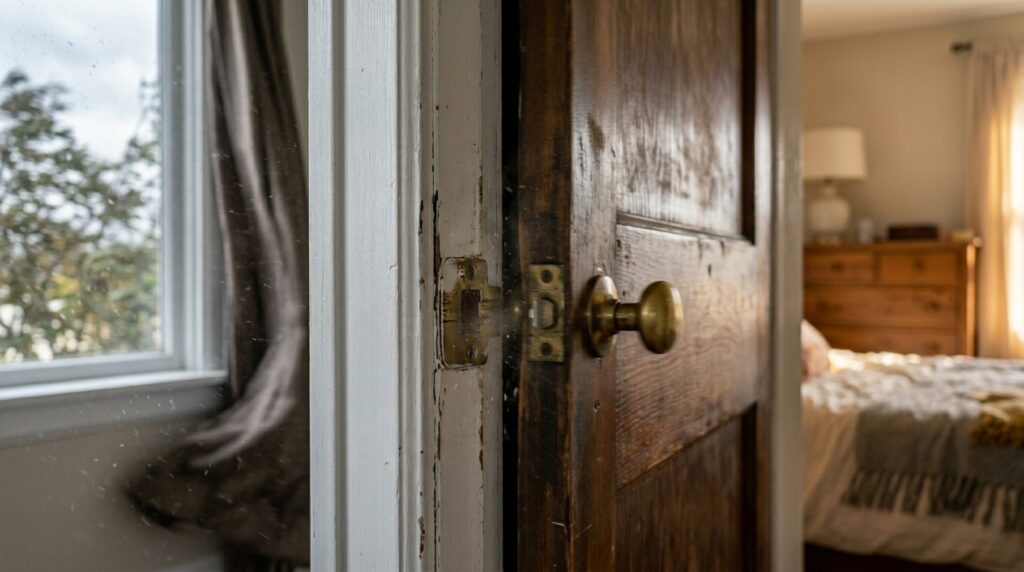
Unsecured door latches and gaps in the frame may act as amplifiers.
It is possible for even very slight flaws in door hardware to greatly exacerbate rattling that is associated with HVAC.
If the latch is somewhat loose, the door will be able to move around inside the frame if there is a change in the air pressure.
The same thing happens when there are unequal gaps between the door and the frame; these gaps generate room for air to move through quickly.
This airflow functions similarly to a channel, causing an increase in vibration when air speeds past apertures that are quite small.
One kind of door that is especially susceptible to this problem is older doors or doors that were fitted without proper alignment.
Repeated movement may also cause screws to become loose over time, which has the additional effect of making the door system more unstable.
What starts off as a very little mechanical gap often develops into a source of noise that is constant.
The Importance of both High-Speed Airflow and the Design of HVAC Ducts
When it comes to the distribution of air pressure throughout the house, the design of the HVAC ducts is an extremely important factor.
Ventilation systems that include ducts that are small or curves that are sharp often compel air to travel at faster rates.
Because of this quick airflow, there are greater pressure variations that occur whenever the system begins or stops.
Sudden bursts of air pressure may occur in the rooms that are closest to supply vents, which can have an effect on the doors that are adjacent.
Duct layouts that are not properly balanced may also result in unequal heating or cooling zones, which can lead to an increase in pressure differences.
Doors that are situated along key air paths are the ones that are most negatively impacted when airflow is not evenly managed.
In order to lessen the impact of these pressure surges and minimize vibration problems, proper duct design and balance are essential.
Why Seals and Weatherstripping Have an Effect on the Stability of Doors
The purpose of weatherstripping and door seals is to prevent air from moving from one room to another; however, they also have the ability to affect the way pressure behaves.
The circulation of air becomes uneven when there are regions where the seals are too tight and other areas where they are lacking.
As a result of this imbalance, air tends to congregate near weaker places, such as the exposed edges of doors.
In the course of the operation of HVAC systems, air will attempt to leave via these weak places, which will result in movement in the door.
On the other hand, seals that are too tight might trap pressure behind the door, which can increase the power of vibration.
It is preferable to have a balanced sealing system that assures controlled airflow rather than abrupt bursts of pressure.
When properly fitted, seals have the ability to greatly minimize rattling without completely blocking airflow.
Alterations to the Door Frames’ Structural Composition and Seasonal Adoption
Alterations in temperature and humidity throughout the year have the potential to gently modify the alignment of door frames.
When exposed to high levels of humidity, wooden frames expand, but when exposed to dry or warm interior surroundings, they shrink.
These minute adjustments have the potential to produce an unequal distance between the door and its frame.
The activation of HVAC systems enables air to contact with the door surface in a more unrestricted manner.
As a consequence of this, even very modest shifts in pressure may cause clearly audible rattling.
Because of natural settling and structural movement that occurs over a lengthy period of time, older houses are more vulnerable.
Helping to prevent these seasonal fluctuations in door alignment is the maintenance of a consistent interior humidity.
Locally Available Solutions to Put an End to the Rattling of Interior Doors
When it comes to fixing door rattling, it is often necessary to make specific modifications rather than large improvements.
For example, one of the easiest and most efficient methods is to secure loose screws and tighten hinges.
When applied at contact sites, the addition of tiny adhesive bumpers or cushioning strips may help minimize vibration.
It is possible to guarantee that the latch will hold the door more securely inside the frame by adjusting the striking plate.
In some circumstances, there are situations in which closing excessive gaps surrounding the frame helps control the passage of airflow.
There is also the possibility of stabilizing airflow at the base of the door by using bottom sweeps or heavier door stops.
Without requiring any modifications to the HVAC system itself, these localized solutions immediately address movement related issues.
Long-term balancing of the heating, ventilation, and air conditioning system and optimization of the home pressure
Make any necessary modifications to the airflow balance of the HVAC system itself in order to achieve a lasting solution.
It is possible for technicians to manage the pressure in the ducts in order to provide a uniform distribution of air across all of the rooms.
It is possible to more effectively regulate pressure differences by installing return vents in appropriate areas to do this.
Regular maintenance of filters and ducts guarantees that there are no abrupt spikes in airflow and that the airflow is steady.
One way to alleviate stress on interior doors and the structures that surround them is to improve the overall ventilation design.
Air flows freely and without generating high localized pressure zones in systems that are well-balanced.
By optimizing them appropriately, interior doors may continue to be sturdy, quiet, and unaffected by the cycles of the HVAC system.