The “Non-Compliant” Glass Epidemic: Why Balcony and Shower Panels Are Spontaneously Shattering
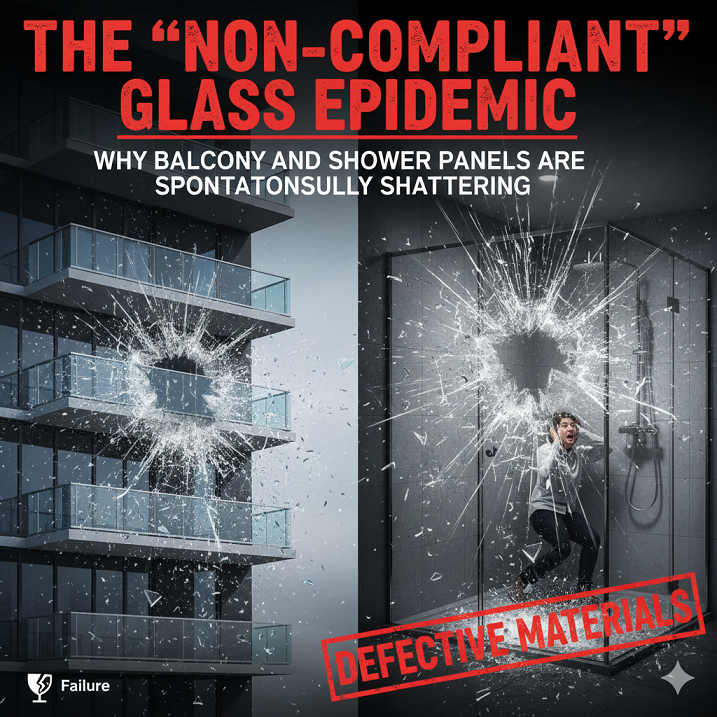
The “Non-Compliant” Glass Epidemic: Why Balcony and Shower Panels Are Spontaneously Shattering
Due to its ability to provide openness, light, and a feeling of luxury, glass has emerged as a distinguishing characteristic of architecture in many contemporary structures. The use of glass for shower panels and balcony railings has become more widespread in both residential and business settings nowadays. Recently, however, a troubling trend has formed in which these glass panels are breaking without any prior warning. It is common for homeowners and tenants to report hearing huge explosions, which are then followed by the shattering of glass into thousands of pieces. Because of these accidents, there are significant issues over safety, compliance, and the quality of the materials. Fear, injuries, and damage to property are examples of effects that are growing increasingly prevalent. The fact that many of these installations are very new is one of the factors that makes the problem even more concerning. A non-compliant glass pandemic is the term that is now being used to describe the situation. Gaining an understanding of the reasons behind this occurrence is critical for avoiding future incidents and preserving the safety of the structure.
An Explanation of What “Non-Compliant” Glass Really Means
The term “non-compliant glass” refers to glass that does not fulfill the necessary requirements for either performance or safety. Glass must be able to survive impact, changes in temperature, and stress over an extended period of time in order to meet these specifications. In the event that glass does not fulfill these standards, it transforms into an unpredictable and hazardous substance. The glass may, in many instances, have the same appearance as goods that are compliant. The manufacturing process and the testing procedures are what make the difference. Without the appropriate tempering or lamination, non-compliant glass may be present. Because of this, its strength and stability are greatly diminished. The likelihood of spontaneous breaking is increased over time by vulnerabilities that are not readily apparent.
Why Tempered Glass Is Supposed to Act in a Certain Way
The purpose of tempered glass is to be more durable than conventional glass and to shatter in a secure manner in the event that it fails. In order to get the desired effect of internal compression, the glass is heated and then quickly cooled throughout the production process. This process causes the glass to shatter into smaller fragments that are less hazardous than the sharp shards that would otherwise be produced. When properly installed, tempered glass is capable of withstanding regular stresses as well as variations in temperature. On the other hand, as long as the procedure is hurried or irregular, the internal tensions will continue to be unequal. As a result of these stressors, abrupt failure may occur. The correct tempering is essential to ensuring safety. Every deviation raises the possibility of breaking that is similar to an explosion.
Deficiencies in the manufacturing process that result in spontaneous shattering
As a result of tiny imperfections that are generated during the production process, spontaneous glass breaking is a significant cause. Within the glass, there is the potential for minute inclusions, contaminants, or uneven cooling to stay concealed. Due to these defects, the underlying structure becomes more fragile over time. The stress that is concentrated around these faults occurs whenever there is a change in temperature or pressure. The glass will eventually reach its breaking point even if it is not subjected to any external force. The failure looks to have occurred all of a sudden, yet it has been in the works for many months or perhaps years. Because of inadequate quality control, damaged glass is able to make its way to installation sites. Shortcuts in manufacturing are a significant factor that contributes to this pandemic.
The Variations in Temperature and the Thermal Stress
The expansion and contraction of glass is a temperature-dependent property. It is possible for there to be significant temperature fluctuations in bathrooms and balconies. Balcony glass is quickly heated by direct sunshine, and shortly thereafter, colder air is followed by the glass. Shower panels are subjected to abrupt contact to hot water while being pressed against surfaces that are colder. The glass experiences thermal stress as a result of these fast structural changes. Safety glass that has been manufactured correctly is able to withstand this force. The glass that does not comply cannot. Repeated temperature cycles cause the material to become more fragile over time. When the tension eventually becomes too great to bear, the glass suddenly breaks in an unexpected manner.
Installing Errors That Raise the Probability of System Failure
In the event that it is not installed properly, even compliant glass might become hazardous. The panel is subjected to continual pressure as a result of fittings that are so tight that there is no space for expansion. As a result of misplaced frames or uneven supports, stress points are created. A weakening of the glass surface might occur during installation if there are even minor chips or scratches. At first glance, these flaws could seem to be completely innocuous. Stress causes them to develop over time, which ultimately results in failure. Inadequate installation exacerbates the flaws that are already present in the glass. Installation that is done correctly is equally as crucial as the quality of the material.
The Reasons Why Balcony and Shower Glass Are Affected Extremely
The environmental stress that balconies and shower panels are subjected to is continual. Balconies are vulnerable to the gusts of wind, the sun, and the fluctuations in temperature. There are daily cycles of heat and moisture that are experienced by shower panels. Glass experiences increased wear and stress as a result of these situations. In addition, these panels often lack frames, which puts additional strain on the glass inside the panel itself. In the absence of supporting framing, each potential flaw becomes more harmful. These locations are considered to be high-risk because to the mix of exposure and design. It is because of this that the majority of the spontaneous shattering episodes take place here.
Real-World Consequences and Potential Dangers to Safety
In the event that glass shatters without warning, there is a substantial possibility of harm. In the vicinity, there may be occupants who have no time to respond. Scratches and other injuries may be caused by flying glass pieces. Split panels provide a risk of falling when they are found on balconies. Damage done to property will also add to the cost burden. Not only do these occurrences cause physical injury, but they also cause dread and a loss of faith in the safety of the structure. The process of replacing broken glass may be both expensive and disruptive. In many cases, the emotional effect is more long-lasting than the repair itself. Deficiencies in safety bring with them severe repercussions.
Approaches that Homeowners and Building Managers Can Take to Decrease Risk
In order to discover early warning indicators, it is helpful to do routine inspections of glass installations. It is never acceptable to disregard even the smallest of cracks, chips, or strange sounds. It is necessary to check that the glass that has been placed complies with safety regulations. It is possible for a professional evaluation to establish whether or not glass is compliant. An intelligent measure would be to replace panels that are dubious before they fail. Installation and maintenance done correctly lessen the danger over the long run. Consciousness is the most effective weapon in the fight against unanticipated mishaps. Protecting both persons and property is the goal of preventative action.