Eliminating Hollow Sounds Under Floor Tiles
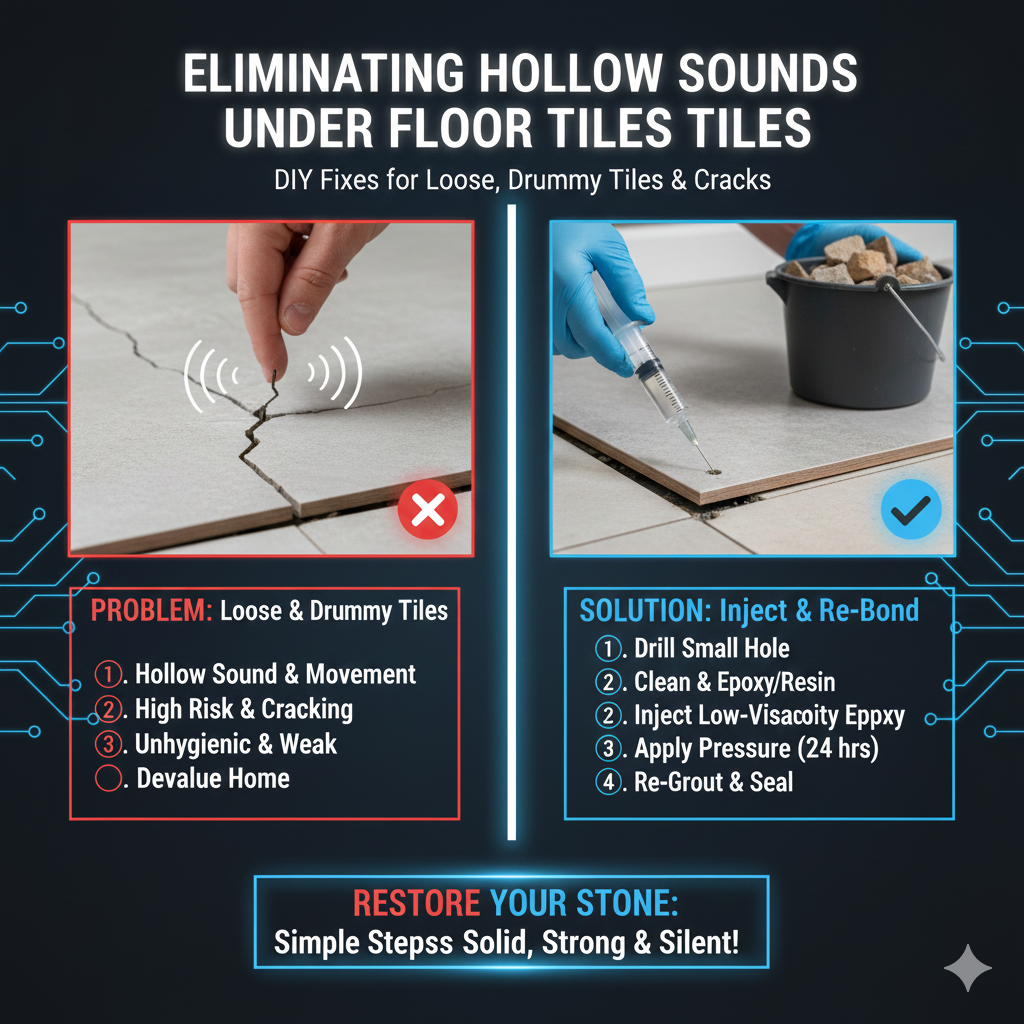
Eliminating Hollow Sounds Under Floor Tiles
If you hear hollow noises when you tap on floor tiles, this is an indication that the tile has not been adequately attached to the subfloor by the glue. These “loose” tiles may seem to be sturdy at first glance; nonetheless, they are susceptible to fracturing, lifting, or cracking as time goes on. The flooring surface will be more durable and safer if issues with hollow tiles are addressed promptly.
Recognizing the Reasons Behind the Empty Resonance
When tiles are not glued properly, air pockets develop, or the subfloor is uneven, it results in the production of hollow noises, which are also known as “tenting” or “delamination.” In addition to the factors mentioned above, there are other causes of hollow tiles, such as moisture problems, inappropriate installation methods, or the use of an incorrect adhesive.
Finding Out Which Tiles Are Hollow
With a rubber mallet or your knuckles, gently tap the tiles. If you hear an echo or if a tile has a hollow sound, that tile is not correctly bonded. You will be able to carefully arrange repairs if you mark these tiles.
Detecting Possible Problems with the Subfloor
The inability to achieve appropriate adhesion is caused by subfloors that are not even or are weak. Check the subfloor for any cracks, voids, or moisture issues that may be present. The subfloor problems may be resolved before the reinstallation process, which will guarantee that the repair is enduring.
Reattaching Tiles that Have Become Disconnected by Utilizing Thinset Mortar
Thinset mortar may be applied fresh and the tile can be lifted to reestablish adhesion in the case of small empty regions. Make sure the mortar is distributed in a uniform layer, firmly push the tile into place, and then take out any excess. Prior to stepping on the tile, you should wait an adequate amount of time for it to cure.
Putting Epoxy or Adhesive Beneath Tiles That Are Already Installed
If it is difficult to lift tiles, liquid epoxy or a specialty glue may be injected under the hollow portion of the tile. Use a syringe or injector to fill up any gaps, and then lightly tap the tile in order to spread the glue evenly. Get rid of any surplus right away.
How to Replace Tiles That Have Been Badly Damaged
In the event that tiles have substantial hollowness, are cracked, or have chips, it is frequently the most effective course of action to remove and replace them. To get a smooth look, match the new tiles with the ones that are already in place, and use the correct glue for the installation.
Making the Subfloor Even, Should the Need Arise
Multiple hollow tiles may be caused by uneven subfloors. Making ensuring that tiles that have been replaced or are new adhere uniformly and maintain their stability may be accomplished by making use of a self-leveling solution or by fixing flaws in the subfloor.
Giving Adequate Time for Curing
For efficient bonding to take place, adhesives need to be given enough time to cure. Refrain from stepping on tiles that have been fixed until the required curing time has elapsed. If the tiles are used before they are ready, they may raise themselves once again.
Keeping Echoes from Reoccurring in the Future
Make sure to use adhesives of a high grade that are appropriate for the kind of tile and subflooring. During the installation process, make sure that the tile spacing is appropriate, that there is complete covering, and that the trowel is applied correctly. Over the course of time, the weakening of adhesive may be prevented by keeping the moisture levels stable.
Performing Regular Examinations
Make it a habit to check tiles for signs of damage such as lifting, cracks, or hollow patches. The ability to spot a problem in its early stages enables one to make the necessary repairs in a timely manner, so avoiding more extensive areas of the flooring from being damaged.
Getting Professional Help When Dealing with Extensive Flooring Problems
In the event that hollow tiles are prevalent, it would be best to consult a professional flooring contractor. Professionals are able to detect the fundamental reasons, which may include structural movement or moisture issues, and are able to perform repairs that are comprehensive in nature and that avoid the recurrence of hollow noises.
Keeping the Floor in Good Condition
Refrain from causing strong impacts, use protective cushions under furniture, and clean tiles using appropriate techniques. You can reduce the amount of stress that is placed on the adhesive and extend the life of your flooring by taking the proper care of it.